.jpeg)
FitSpine Physio • Personal physiotherapy brand
FitSpinePhysio is built around a single practitioner with a strong existing audience and reputation developed through social media.
Before the website, all communication and client acquisition happened through platforms like Instagram and Facebook, without a structured space to present services, expertise, or approach.
The challenge was not visibility, but control: shaping how that expertise is understood outside social media.
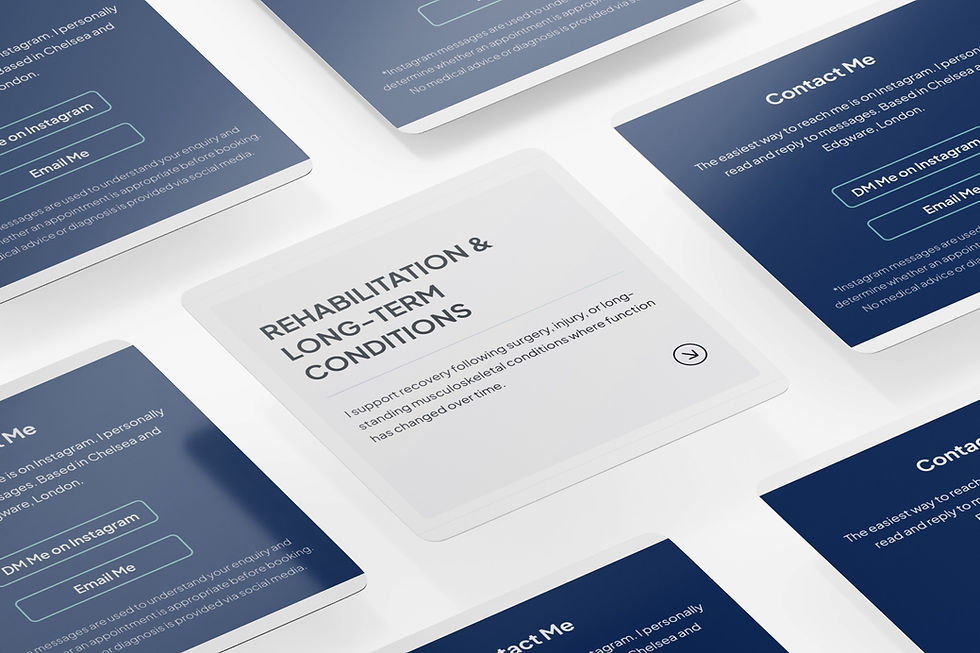
What Shaped The Direction
THE CORE PROBLEM
Daniel had an established personal presence and growing visibility through social media, but needed a website that could turn that attention into trust, clarity, and enquiries.
The challenge was to design a physiotherapy website around a personal brand rather than a traditional clinic model, positioning Daniel as the trusted expert while organising his services, clinical approach, and social media credibility into a clear user journey.
An already established personal brand with a large audience.
A preference for direct, informal client communication (DM-based).
No traditional clinic structure or booking system.
A need to attract higher-quality, more serious clients.
Design Scope
The visual direction builds on an already existing identity, refining it into a more controlled and consistent system.
-
A dark, minimal palette (deep navy, near-black, grey tones) creates a premium, focused atmosphere
-
Subtle blue-grey accents maintain a connection to the medical field
-
Clean, modern typography reinforces clarity and authority without over-styling

The project required balancing:
-
Personal brand vs professional authority
-
Simplicity vs credibility
-
Direct communication vs structured experience
-
Influence vs clinical expertise
The overall direction avoids decorative or overly polished aesthetics, keeping the focus on the practitioner and his expertise.

Why this mattered
REFRAMING personal brand
Rather than imposing a traditional clinic structure, the website was designed to support the existing way of working.
This meant:
Keeping the experience simple and direct.
Using the website as a filter and framing tool, not a booking system.
Structuring information to help patients understand suitability before initiating contact.
Reinforcing authority through clarity, not complexity.

Key Structural Decisions
No booking system, contact remains direct via Instagram (and future WhatsApp).
Presentation-led structure focused on expertise, approach, and conditions.
Therapies and tools explained to support understanding, not selection.
Case studies used to demonstrate clinical reasoning, not just results.
Users guided toward contact only after understanding suitability.

Scope
Website UX/UI design
Website implementation
Visual identity refinement
Structure and content logic
Messaging adaptation for a broader, non-medical audience

What makes this Bussiness model different
Practitioner-led, highly personalised approach.
Strong existing audience and reputation.
Selective client intake through direct interaction.
Positioned between personal brand and clinical expertise.
Result
design how expertise is perceived,
even when the business model is unconventional.
The result is a structured digital presence that strengthens authority while preserving the flexibility of a personal brand.
The website provides clarity and context before direct contact, helping position the practitioner in a more professional and intentional way, without changing how the business operates.
It establishes a controlled environment where expertise is communicated clearly, supporting better quality interactions over time.